
Europe's Heatwave Economy: The Investment Opportunities Emerging from a Hotter Continent

by Ethan Hall
Europe's accelerating heatwaves are no longer simply an environmental story. They are becoming one of the most important investment themes of the coming decades. Across Europe, temperature records were shattered in June. The continent is warming faster than any other, with temperatures rising at roughly twice the global average rate. Europe has warmed by around 0.53°C per decade over the last 30 years, while heat stress events continue to increase across the region1.
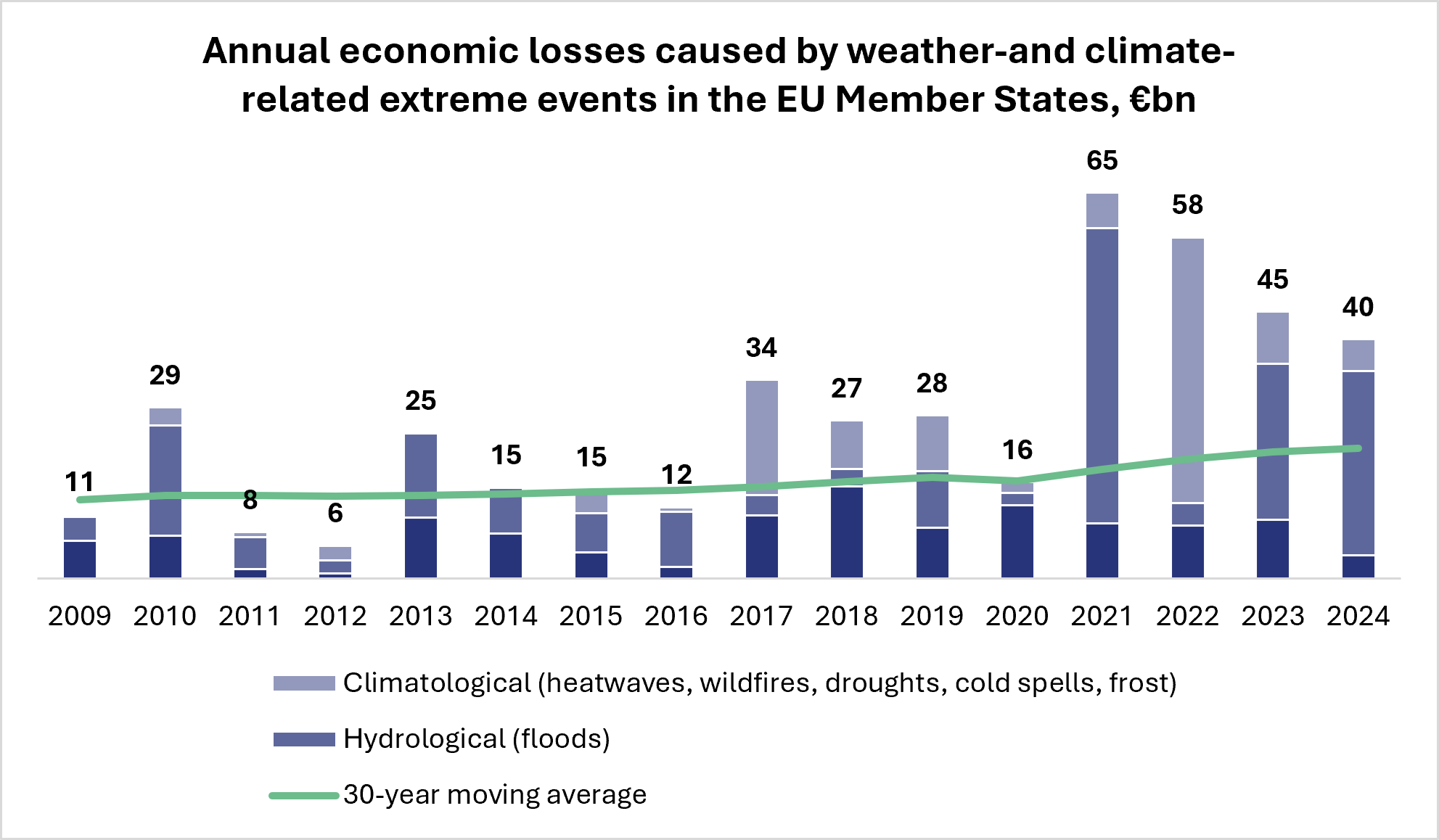
The economic consequences are clear, with weather and climate related extremes causing economic losses of assets estimated at €822 billion during 1980 - 2024 in the European Union, with over €208 billion (25%) between 2021 and 20242. Furthermore, research3 from the European Central Bank has found that extreme weather events could account for a loss of up to 5% of euro area economic output in the next five years, which would be on par with the great financial crisis.
A study4 of publicly listed firms in the USA found that negative impacts from extreme weather events caused a cumulative average abnormal stock return of -2.36% per event. The total firm value losses accumulate to $2.709 trillion USD (inflation-adjusted) between 2005 and 2024, which are primarily driven by direct asset impacts.
Globally, projections based on a global temperature rise of 1.5°C by the end of the twenty-first century suggest that heat stress is expected to reduce total working hours worldwide by 2.2 per cent and global GDP by $2.4 trillion in 2030 – a productivity loss equivalent to 80 million full-time jobs5.
Historically, climate investing focused overwhelmingly on mitigation technologies such as renewable energy and electric vehicles. That is changing. Investors increasingly recognise that some climate impacts are unavoidable, creating demand for solutions that help societies adapt.
Evidence suggests adaptation investments can generate attractive returns. The Institutional Investor Group on Climate Change notes that resilience upgrades can improve returns through lower insurance costs, reduced lifecycle expenses, and improved productivity. BCG and the Global Resilience Partnership estimates that ‘every dollar a company invests in implementing adaptation and resilience measures can yield $2–15 in financial benefits’6.
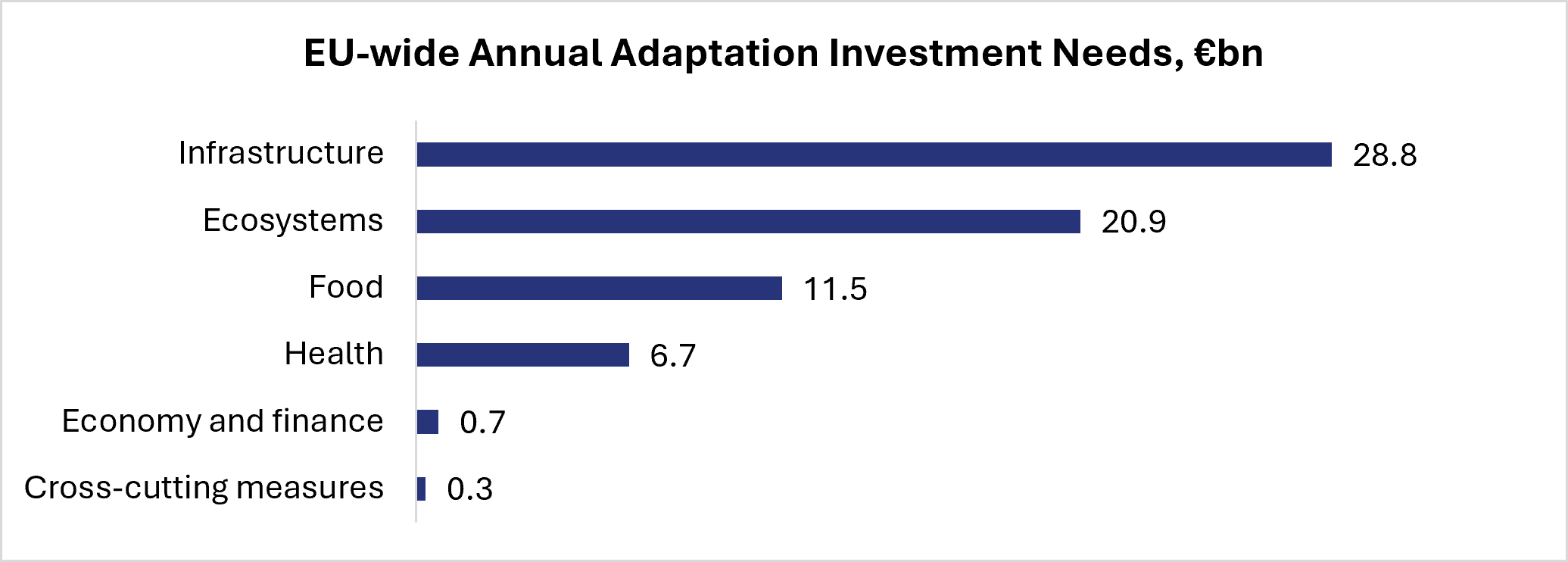
Meanwhile, only around one in five companies currently has a formal adaptation plan7, suggesting adoption remains in the early stages. This is evidenced by the ~€70 billion climate adaptation annual investment gap in the EU8.
Public-Private Combination
The public and private sectors must work together to help ensure that adaptation finance is unlocked. For example, public finance is essential for funding upstream public goods that private actors depend on but cannot provide themselves. These include climate information systems, weather and risk data, early warning infrastructure, land-use planning, and other resilience-related services9.
Furthermore, public adaptation spending has been found to crowd in private investments in adaptation. If public adaptation spending increases by 1%, private climate change adaptation investments are expected to rise by 0.28% over the same period10.
The Rise of the Adaptation Economy – Cooling is an Obvious Growth Market in Europe
Adaptation spending is growing rapidly from a relatively low base. A paper10 from Arbués et al. (2025) found that climate adaptation investment across the EU and UK increased from €15.4 billion in 2018 to €52.9 billion in 2022, representing a 243% increase in just five years.
Yet spending remains far below what is likely to be required. The Climate Change Committee11 estimates the UK alone will need around £11 billion annually of adaptation investment, split between public and private sectors, while global demand for climate adaptation and resilience investments could reach between $500 billion and $1.3 trillion annually by 203012.
While limitations on private sector engagement in adaptation exist, such as a lack of predictable revenue streams and benefits which can often be difficult to quantify, the investment case is straightforward. As climate risks become more severe, spending on resilience increasingly resembles essential infrastructure rather than discretionary expenditure.
Perhaps the clearest opportunity lies in cooling technologies.
Only around one in five European homes currently has air conditioning, according to the International Energy Agency, compared with close to 90% in the United States. Penetration remains particularly low in countries such as Germany, where only 7% of homes have air conditioning13. The UK's Climate Change Committee11 estimates that hotter heatwaves could cause 92% of existing homes to overheat and researchers at Harvard14 estimate that under a high-emissions scenario, as much as 92% of Germany's population could require air conditioning during extreme heat events.
The recent heatwaves have already led to a surge in demand for air conditioners, with Midea sales through German e-commerce channels rising about 37% in May from a year earlier, and shipments in Spain and France increasing by 108%15.
This creates a long runway for companies involved in residential and commercial cooling, but the opportunity extends beyond traditional air conditioning manufacturers. Technologies that reduce cooling demand – including reflective roofing, smart shading, radiative cooling systems, and building retrofits – could enjoy decades of structural growth.
The Grid Upgrade Boom and Built Environment Resilience
A hotter Europe means a more electrified Europe. Every additional cooling unit increases pressure on power networks that were not designed for prolonged periods of extreme summer demand. The result is likely to be significant investment in grid modernisation, better storage solutions and demand management software to wrap around it all.
The investment thesis mirrors previous infrastructure booms. As cooling demand grows, Europe's electricity system requires substantial upgrades to maintain reliability during summer peaks. Companies providing grid monitoring, AI-based energy management, and long-duration storage technologies are positioned to benefit from this transition.
On a smaller investment scale, equipment heat tolerances have been exceeded where operation is outside of temperature-controlled environments. Supermarket fridges in the UK are typically designed to operate in temperatures up to ~32C16 – the recent UK heatwave saw a number of supermarkets failing to maintain cold storage for products on sale resulting in empty shelves and lost income. As a result, Marks & Spencer have recently invested in refrigeration equipment that can cope with weather as hot as 45C17. Other vulnerable areas include HVAC and external installations/materials, but the impact will also be felt on demand for solutions to reduce solar gain (shading and special glass) as well as control mechanisms such as Smart Building systems. Morgan Stanley18 identifies climate resilience upgrades as one of the clearest adaptation opportunities, particularly for firms involved in retrofitting existing building stock and constructing more resilient infrastructure.
Urban Cooling Infrastructure
One of the most overlooked opportunities may be urban heat mitigation.
World Resources Institute research19 shows that trees can make urban environments feel up to 8°C cooler, while a study20 found that almost 40% of heat-related deaths in European cities in 2015 could have been prevented if tree cover had reached 30% of their land area.
As cities increasingly invest in heat-resilience programmes, opportunities emerge in urban greenscaping, design, and resource management, including Smart City technologies and water management systems These projects are likely to receive growing public support as governments seek lower-cost alternatives to purely energy-intensive cooling solutions.
Climate Intelligence and Risk Analytics
A newer and rapidly growing sector is climate-risk analytics.
Private equity funds, insurers, and asset managers are increasingly spending significant sums to model heat risk, insurance costs, and adaptation requirements. Bloomberg21 recently reported that private equity firms have become major customers of climate analytics providers, reflecting the growing need to quantify physical climate risk.
This creates opportunities for firms providing climate data services, predictive modelling, satellite monitoring, risk-analysis platforms, and adaptation planning software and consultancy.
Venture capital investment into climate-monitoring technologies reached $245 million in the first quarter of 2026 alone21.
Industrial Automation and Workforce Protection
Extreme heat deteriorates working conditions and reduces productivity, particularly in labour-intensive industries.
Research22 suggests climate finance can reduce heatwave welfare costs partly through investments in industrial robotics and automation. A key use case for autonomous robotics is in hazardous environments, so Governments and businesses may look to develop robots that withstand extreme temperatures, operate efficiently, and perform tasks that mitigate the risks and impacts of high temperatures on human workers.
As temperatures rise, replacing heat-exposed manual labour with automation becomes both an adaptation strategy and a productivity investment. In addition, worker safety technology – such as heat monitoring and wearable cooling – is likely to be considered alongside full automation.
The Bottom Line
Europe's heatwaves represent a structural economic challenge, but also a significant investment opportunity.
The continent faces rising costs from overheating buildings, strained power grids, declining labour productivity, and growing climate-related damage. Yet those same pressures are creating long-term demand for cooling technologies, resilient infrastructure, climate analytics, building upgrades, and urban adaptation solutions.
Just as decarbonisation produced a generation of investment winners, the next phase of climate investing may belong to the businesses that help Europe function in a hotter world. The adaptation economy is still emerging, but the direction of travel is increasingly clear: as heat becomes a permanent feature of European life, resilience is becoming an asset class in its own right.
Sources
1 – Copernicus
2 – European Environment Agency
4 – Schimanski, Tobias and Gostlow, Glen and Toetzke, Malte and Leippold, Markus, What Firms Actually Lose (and Gain) from Extreme Weather Event Impacts (January 06, 2026). HKU Jockey Club Enterprise Sustainability Global Research Institute Paper No. 2026/003, Available at SSRN: https://ssrn.com/abstract=6035794 or http://dx.doi.org/10.2139/ssrn.6035794
5 – International Labour Organization
6 – Investor Group on Climate Change
7 – Laidlaw, J., Bowles, S. & Beckwith, H. Adaptation planning is the next step for companies to prepare for climate risk. S&P Global https://www.spglobal.com/esg/insights/adaptation-planning-is-the-next-step-for-companies-to-prepare-for-climate-risk (2023).
8 – European Commission via Bloomberg
9 – United Nations Development Programme
10 – Cortés Arbués, I., Chatzivasileiadis, T., Storm, S. et al. Private investments in climate change adaptation are increasing in Europe, although sectoral differences remain. Commun Earth Environ 6, 470 (2025). https://doi.org/10.1038/s43247-025-02454-3
12 – BCG
13 – Financial Times
14 – Harvard John A. Paulson School of Engineering and Applied Sciences
15 – The Independent
16 – BBC News
17 – The Guardian
18 – Morgan Stanley
19 – World Resources Institute
20 – Iungman T, Cirach M, Marando F et al. Cooling cities through urban green infrastructure: a health impact assessment of European cities. The Lancet, 2023; 401, 577-589
21 – Bloomberg
22 – Congyu Zhao, Kangyin Dong, Rabindra Nepal, Kerstin K. Zander. The panacea of heatwaves: Can climate finance mitigate heatwave welfare costs? International Journal of Disaster Risk Reduction. Volume 117, 2025, 105197, ISSN 2212-4209
Latest news
-
04 Sep 2026

Luminii provides CDD and strategy support to YFM on their recent follow-on investment in Biorelate
-
06 Aug 2026
Europe's Heatwave Economy: The Investment Opportunities Emerging from a Hotter Continent
-
27 Jul 2026
Luminii provides Commercial Due Diligence support to Ideagen on their acquisition of Work Wallet
-
17 Jun 2026

Beyond the Megadeal: The Quiet Roll-Up Revolution in European Cybersecurity
-
20 May 2026

Luminii provides strategic & CDD support to YFM and GEEIQ’s Management team on YFM’s follow-on investment